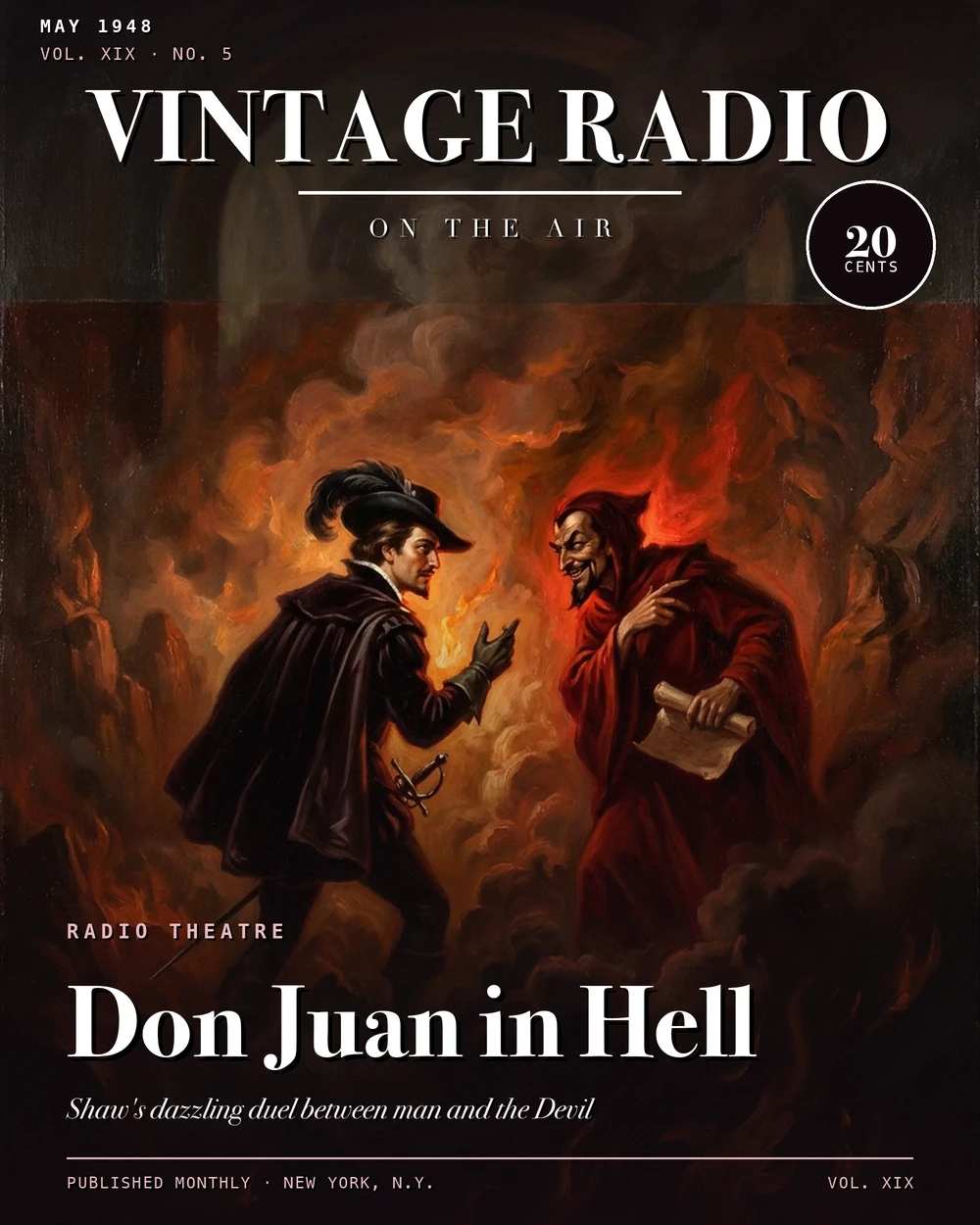
Don Juan in Hell
What It Actually Is
Most radio dramas tell a story. Don Juan in Hell argues one. The piece is drawn from Act III of George Bernard Shaw's 1903 play Man and Superman — specifically a dream sequence so philosophically dense and theatrically unusual that Shaw himself wasn't sure it could work on stage, writing that "The Hell scene is such a queer business that I can't advise you to experiment with it, but I should certainly like you to try it." That combination of doubt and curiosity turned out to be well-founded: the scene has proven stubbornly fascinating across more than a century of productions. Shaw began sketching a "Parliament in Hell between Don Juan and the Devil" in May 1900, finished Man and Superman in June 1902, and the Hell sequence received its first separate stage performance at the Court Theatre in London in 1907.
The piece has exactly four characters: Don Juan, Doña Ana, the Devil, and the Commander (also called the Statue) — all rooted in the characters of Mozart's opera Don Giovanni. There is no conventional plot. What the four characters do, at length and with great verbal precision, is debate. Don Juan defends the life of the mind and what Shaw called the Life Force — humanity's drive toward self-consciousness and higher organization. The Devil counters with the claims of pleasure and beauty. The Oxford Dictionary of Plays notes that the scene functions as "a philosophical debate which informs the comic outcome" of the full play, but it lands just as hard when taken on its own terms.
The Production That Made It Famous
The most celebrated audio realization of Don Juan in Hell wasn't a traditional radio broadcast — it was Paul Gregory's First Drama Quartette, directed by Charles Laughton, which launched in early 1951 and toured 35 states plus England and Scotland, hitting more than 105 cities before landing on Broadway for a return engagement that ran November 29 through December 31, 1951. The casting was remarkable: Charles Boyer as Don Juan, Laughton himself as the Devil, Sir Cedric Hardwicke as the Commander, and Agnes Moorehead as Doña Ana. The staging stripped everything away — a bare stage, four stools, four microphones, and the actors in evening dress. The material carried the evening entirely on the strength of the language and the voices delivering it.
The commercial results were startling. Time magazine reported that the production proved "a steady sellout everywhere, in arenas, theaters and stadiums, outgrossing South Pacific in Denver," and that Carnegie Hall's tickets sold out in eight hours. Total receipts reached approximately $500,000. In 1952, Columbia Records released the production as a two-LP box set (Columbia SL-166, mono), preserving the performance in audio form. That recording is the foundation of what survives in circulation and, not coincidentally, what makes an audio catalog entry for this piece make immediate sense — the work was conceived to be heard as much as seen.
Shaw on the Air
Beyond the First Drama Quartette's celebrated run, Don Juan in Hell found its way to radio on both sides of the Atlantic. The BBC broadcast the complete Man and Superman — including the Hell sequence — on the Third Programme in 1946, directed by Peter Watts, with John Garside, Leonard Sachs, Sebastian Shaw, and Grizelda Hervey. The Third Programme was the BBC's home for serious literary and musical programming, and placing Shaw's most demanding material there was a deliberate statement about what radio could hold.
Decades later, in 1996, BBC Radio 3 returned to the piece to mark the station's 50th anniversary, producing Don Juan in Hell with Ralph Fiennes as Jack Tanner, Judi Dench, John Wood, and Juliet Stevenson. The choice of this particular work for an anniversary celebration says something about its durability — Shaw's argument about desire, temptation, morality, and what happens after death hasn't lost much of its edge. The dialogue between Don Juan and the Devil remains sharp enough to hold a room, or fill an hour of radio, without any production machinery propping it up.
The catalog here contains four episodes drawn from the production. Shaw's Hell scene runs long by design — it's a play-within-a-play built around sustained intellectual combat — and the four-part structure reflects that scale. The arguments don't resolve neatly, which is probably the point.